The Architectural Standards of Professional Tile Installation (2026)
Master the architectural standards for a flawless tile installation. Our 2026 guide covers TCNA guidelines, substrate prep, and waterproofing for lasting res...
A flawless tile surface is not merely an aesthetic achievement. It is a byproduct of rigorous structural engineering that remains invisible to the naked eye. While high-end porcelain and natural stone define the visual character of a room, the technical integrity of the tile installation determines whether that beauty lasts for a season or a lifetime. You likely recognize that a premium renovation requires more than just a steady hand; it demands an unwavering adherence to architectural standards that prevent the common frustrations of cracked grout and uneven lippage.
This article provides an authoritative look at the technical requirements and precision standards necessary for high-end residential projects. We examine the 2026 TCNA Handbook guidelines for substrate flatness and the mandatory waterproofing protocols essential for custom showers. You will gain a clear understanding of the technical rigor required to ensure structural longevity and absolute confidence in the caliber of your installation. This guide moves beyond surface-level design to focus on the disciplined assembly that creates a permanent, heirloom-quality finish.
Key Takeaways
- Understand why professional tile installation is defined as a multi-layered structural assembly rather than a simple cosmetic application.
- Master the critical substrate deflection ratings, such as L/360 and L/720, that are necessary to prevent structural failure in natural stone and porcelain.
- Learn to evaluate high-performance materials based on their mechanical properties and environmental suitability for high-traffic residential spaces.
- Discover how architectural layout planning eliminates visual flaws like sliver cuts and ensures a perfectly balanced, symmetrical finish.
- Identify the maintenance requirements and grout specifications, including epoxy options, that safeguard the long-term integrity of your renovation.
The Distinction of Professional Architectural Tile Installation
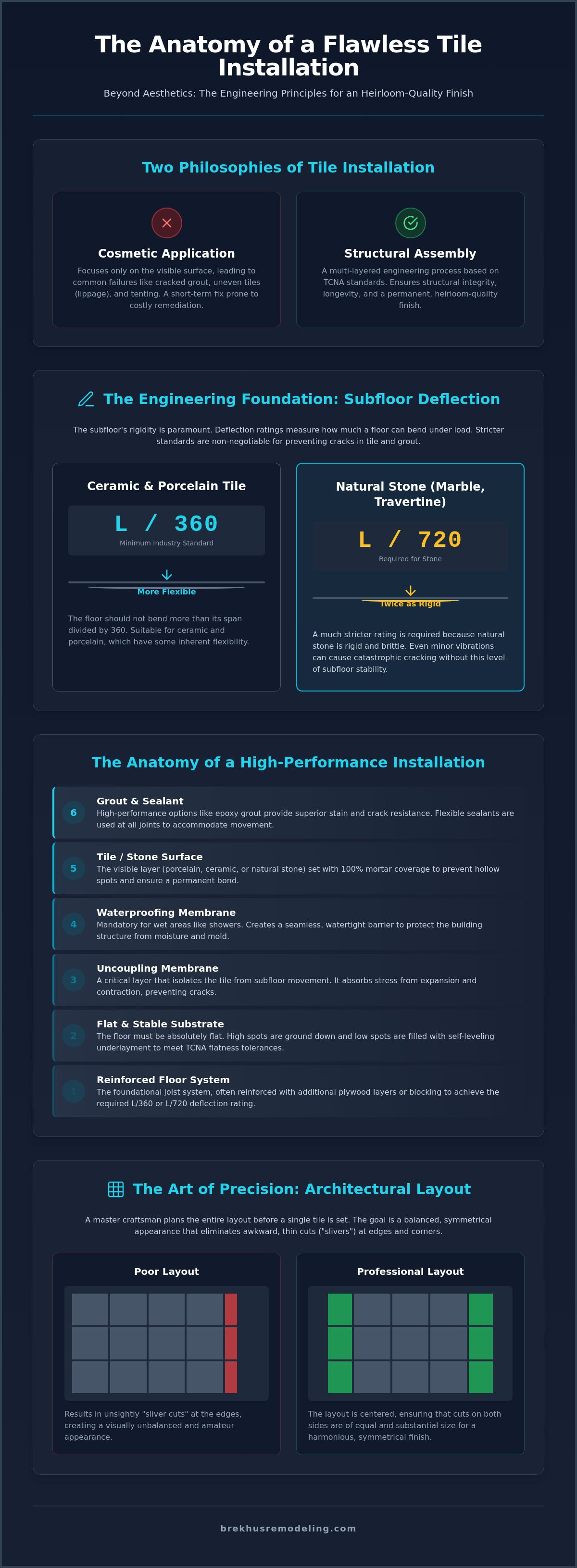
Professional tile installation is frequently misunderstood as a purely cosmetic trade. In reality, high-end residential projects require a multi-layered engineering process where the tile is merely the final component of a complex architectural assembly. This distinction is critical for homeowners who prioritize structural permanence over temporary aesthetics. Organizations like the National Tile Contractors Association (NTCA) emphasize that adhering to rigorous standards is what separates a master craftsman from a standard laborer. The Tile Council of North America (TCNA) establishes the industry benchmarks that dictate every phase of the build. These standards ensure that the finished surface remains stable under environmental and physical stress, preserving the integrity of the home for decades.
Aesthetic Excellence vs. Structural Integrity
The visual appeal of a custom bathroom or kitchen is a direct reflection of the hidden layers beneath the stone. Precision in tile installation relies on the absolute flatness of the substrate and the correct application of specialized waterproofing membranes. Without this technical foundation, even the most expensive marble is prone to catastrophic failure. Common issues like tenting, where tiles lift from the floor, or hairline grout cracks are almost always the result of improper preparation or inadequate mortar coverage. Achieving minimal grout lines and perfect geometric alignment requires a level of accuracy that exceeds basic construction practices. It is a disciplined approach where every millimeter of the build is calculated to support the specific weight and expansion characteristics of the material.
The Value of Master Craftsmanship in Denver Estates
For luxury properties in the Denver area, the expectations for custom stone and tile work are exceptionally high. Selecting a specialized home remodeling contractor ensures that these complex projects are managed with the necessary technical expertise. Investing in professional rigor provides a significant long-term return by preserving the structural integrity of the residence. Quick-fix solutions often lead to costly remediation within a few years of completion. By contrast, a bespoke installation focuses on high-performance materials and meticulous assembly. This creates a finish that enhances both the utility and the market value of the estate. This commitment to quality is the hallmark of a specialist who takes full responsibility for the enduring success of a renovation.
The Engineering Foundation: Substrate Preparation and Waterproofing
The engineering foundation of any successful tile installation is the substrate. It is the invisible skeleton that supports the entire weight of the architectural assembly. A professional assessment begins with evaluating the structural floor system for stability and rigidity. This is not a matter of visual inspection but of mathematical calculation. The Tile Council of North America (TCNA) provides the definitive blueprint for these procedures through the TCNA Handbook for Ceramic, Glass, and Stone Tile Installation. Adhering to these documented standards ensures that the tile remains a permanent fixture rather than a temporary surface.
Deflection ratings are the industry standard for measuring subfloor flexibility. For ceramic and porcelain materials, the standard is L/360, meaning the floor should not bend more than the span divided by 360 under a concentrated load. Natural stone requires a much stricter L/720 rating. Stone lacks the internal flexibility of ceramic; even minor vibrations or shifts in the subfloor will lead to catastrophic cracking without this level of structural rigidity. Achieving these ratings often requires reinforcing the joist system or adding layers of specialized exterior-grade plywood before the first tile is set.
Managing Deflection and Structural Movement
Subfloor flexibility directly impacts tile longevity. In regions like Denver, seasonal climate shifts cause significant expansion and contraction in wooden framing and concrete slabs. Professional installers use uncoupling membranes to manage this movement. These high-performance underlayments act as a buffer, isolating the tile from the structural stress of the building. This prevents the transfer of lateral movement, ensuring that a shift in the foundation doesn't manifest as a crack in your floor. This technical planning is essential for maintaining the integrity of large-format tiles and intricate patterns.
Advanced Waterproofing for Custom Showers
Modern standards for custom shower builds have shifted away from traditional loose-laid liners toward integrated, bonded waterproofing systems. This approach creates a vapor-tight envelope that is essential for steam showers and high-end master suites. Every transition, drain assembly, and corner must be sealed with precision to prevent moisture from reaching the framing. Before any tile is applied, a rigorous flood test is performed. The shower pan is filled with water and monitored for 24 hours to verify absolute seal integrity. This technical rigor ensures that the luxury finish is backed by a fail-safe structural barrier. For those planning complex renovations, partnering with a specialist in premium tile installation ensures these engineering standards are met without compromise.
Evaluating High-Performance Materials: From Porcelain to Natural Stone
The selection of materials for a high-end project is a calculated engineering decision. While aesthetics drive the initial design, the mechanical properties of the chosen medium dictate the ultimate success of the tile installation. Ceramic, porcelain, and natural stone each possess distinct characteristics regarding density, water absorption, and load-bearing capacity. Professionals must evaluate these factors against the specific demands of the room environment to ensure long-term performance. A failure to match the material to its intended use often results in premature wear or structural compromise.
Porcelain vs. Natural Stone Standards
Porcelain is often the preferred choice for high-traffic residential kitchens due to its exceptional density and low porosity. It withstands heavy foot traffic and chemical exposure without the risk of staining or etching. In contrast, natural stones like marble, granite, and quartzite offer a bespoke aesthetic but require a higher level of technical oversight. The National Tile Contractors Association provides rigorous guidelines for the handling and sealing of these premium materials to prevent moisture-related discoloration. Safety is another critical technical metric. The Dynamic Coefficient of Friction (DCOF) must be assessed for all flooring applications to ensure slip resistance. This is particularly vital in wet areas like master bathrooms where natural stone may be more porous and prone to slickness.
The Rise of Large-Format Tile in Modern Design
Modern architectural trends increasingly favor large-format tile (LFT) panels, defined as any tile with at least one edge exceeding 15 inches. These expansive surfaces create a seamless visual impact by significantly reducing the number of grout lines. However, the technical requirements for LFT are exceptionally high. Substrate flatness is non-negotiable. Any variance in the subfloor will lead to lippage, where the edges of the tiles are not flush. This is especially vital in comprehensive flooring installation projects where wide-open spaces amplify even minor imperfections.
Installing LFT requires specialized mortars with high-bond strength and specific troweling techniques to achieve 95% coverage. This ensures the panels are fully supported and prevents cracking under pressure. Natural stone panels also require careful sealing to manage their inherent porosity. Quartzite and granite offer ruggedness, but their installation must account for the weight and the unique structural demands they place on the home framing. Every material choice represents a balance between visual grandeur and the technical rigor required to sustain it.

The Execution Phase: Precision Layout and Installation Standards
Execution represents the stage where architectural theory is translated into a tangible, high-performance surface. A professional tile installation is defined by a layout that respects the inherent geometry of the space. This process involves mapping the entire floor or wall area to ensure patterns are symmetrically balanced. Focal points, such as a centered shower drain or a kitchen island, must align perfectly with the tile grid. This level of planning eliminates sliver cuts, those narrow, distracting strips of tile often found at the edges of poorly planned projects. Proper layout also accounts for the transition between different rooms, ensuring a seamless flow that maintains the home's architectural integrity.
Architectural Layout and Pattern Symmetry
Mapping a room requires more than just finding the center point. It involves a comprehensive survey of the walls and subfloor to identify any out-of-square conditions. In large open-concept areas, installers must plan for expansion joints. These are essential for managing the natural movement of the building and preventing the tile from tenting or cracking. Professional standards dictate that these joints be integrated into the design, often hidden under transitions or filled with color-matched 100% silicone sealant to maintain a clean aesthetic. This foresight ensures the installation remains stable despite Denver's fluctuating indoor humidity levels.
Mortar Application and Bonding Integrity
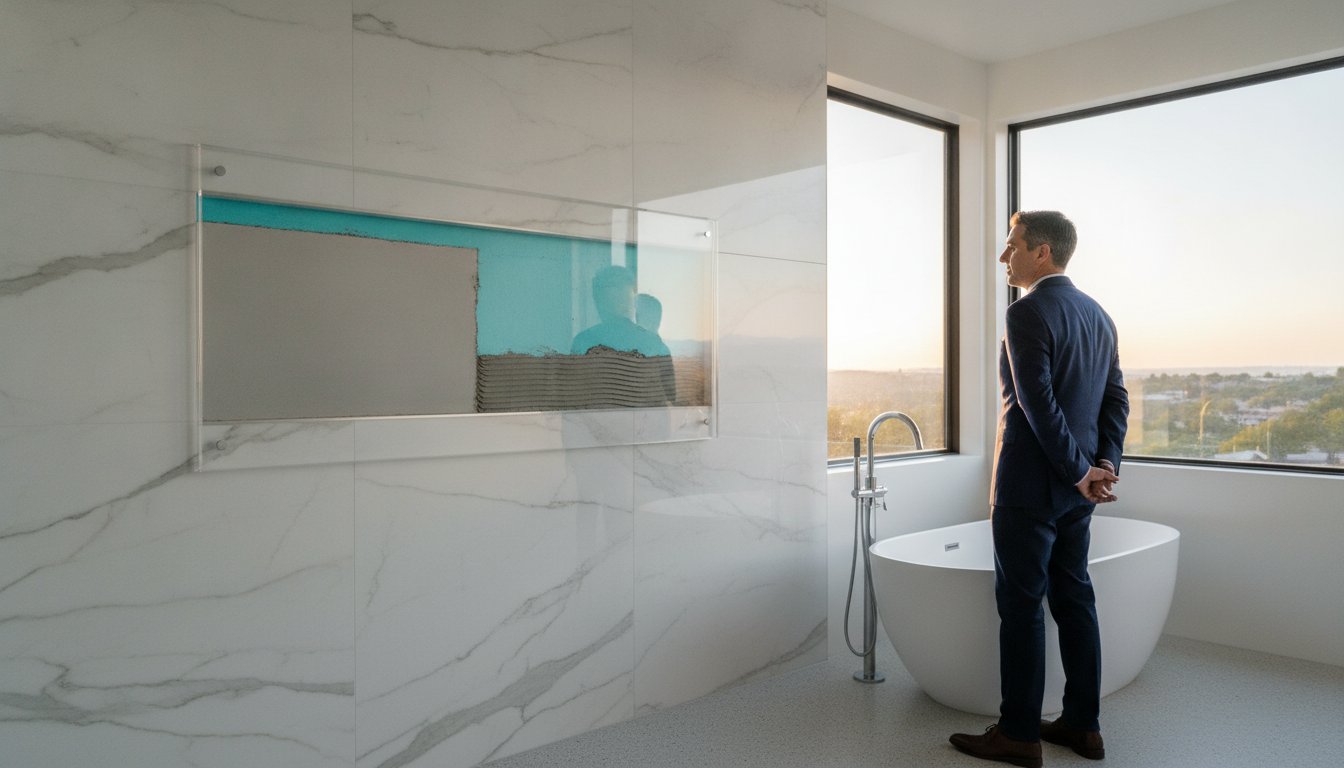
The bond between the tile and the substrate is the most critical technical element of the assembly. For high-end residential projects, achieving 95% mortar coverage is the non-negotiable standard for floors and wet areas. This eliminates hollow spots that could lead to cracked tiles under impact or moisture accumulation in shower stalls. To achieve this, master craftsmen utilize the back-buttering technique, applying a thin layer of mortar to the back of the tile before setting it into the notched trowel ridges on the substrate. This ensures a complete mechanical bond and maximum air release.
- Thin-set Selection: Mortar is selected based on the specific tile density and the environmental conditions of the room.
- Trowel Geometry: The size and angle of the notched trowel are calculated to provide the exact bed thickness required for the tile format.
- Lippage Control: Mechanical leveling systems are employed to pull tiles flush, ensuring a perfectly flat surface without uneven edges.
Managing cure times is equally vital. Varied humidity and temperature can alter the chemical set of the mortar, requiring a disciplined approach to timing and foot traffic. Every step of this phase is designed to create a surface that is as structurally sound as it is visually perfect. For homeowners who demand this level of technical precision, partnering with an expert in custom tile installation is the only way to guarantee a result that meets architectural standards.
Ensuring Longevity: Maintenance and Professional Oversight
The final stage of a professional tile installation is the application of grout and sealants. This phase serves as the critical barrier against moisture infiltration and structural degradation. Choosing the correct medium is an engineering decision based on the intended use of the space. In luxury residential kitchens, epoxy grout is the undisputed standard. Unlike traditional cement-based options, epoxy is non-porous and chemically resistant. It prevents staining from oils and acids, ensuring the aesthetic remains pristine under heavy daily use.
The Science of Grout and Sealants
Color consistency in grouting depends on precise execution. Variations in water-to-powder ratios or improper mixing speeds lead to splotchy results or weakened joints. A disciplined professional monitors these variables to achieve a uniform, high-performance finish. Additionally, the use of 100% silicone sealants at all plane changes, where walls meet floors or corners, is mandatory. These flexible joints accommodate the minor settling and thermal expansion inherent in any structure. It's the only way to prevent the grout from cracking or dislodging as the building moves through seasonal cycles.
Maintaining the integrity of natural stone requires a commitment to post-installation care. While porcelain is largely maintenance-free, premium stones like marble and quartzite benefit from periodic high-quality sealing to protect their porous surfaces. This is not a task for generalists. Professional oversight ensures that the correct chemical sealants are matched to the specific mineralogy of the stone. This preserves its heirloom quality and prevents the deep-seated discoloration that can occur in high-moisture environments like custom showers.
The Brekhus Standard for Residential Excellence
Brekhus Remodeling maintains a standard of technical rigor that Denver homeowners have trusted for over two decades. Our expertise in custom shower installs and stone projects allows us to manage the transition from structural remodeling to final finish work with absolute precision. We don't view tile as a decorative overlay. Instead, we treat it as a permanent architectural assembly that requires specialized knowledge of both chemistry and physics.
Our commitment to excellence is reflected in the longevity of our projects. By providing a seamless transition between the structural build and the final aesthetic layer, we ensure every component of the system works in harmony. Denver estate owners choose us because we provide a steady, reliable partnership for complex, high-stakes renovations. This disciplined approach ensures your investment is protected by master craftsmanship and an unwavering commitment to structural permanence.
Engineering Permanent Excellence in Your Home
Professional architectural tile installation is a rigorous structural discipline where the invisible preparation dictates the visible success. Achieving a flawless, heirloom-quality finish requires more than aesthetic intuition; it demands an unwavering commitment to substrate deflection ratings, integrated waterproofing systems, and precise mortar coverage. By prioritizing these engineering standards over quick-fix solutions, you ensure the structural longevity and enduring value of your residential investment. These technical foundations prevent the common failures that often plague standard renovations.
Since 2004, Brekhus Remodeling has served as Denver's authority on structural remodeling and architectural finishes. We specialize in high-end bathroom and kitchen transformations that require sophisticated technical oversight and master craftsmanship. Our team manages the complex intersection of structural integrity and bespoke design with absolute confidence. We take full responsibility for every layer of the build, ensuring that your custom stone and tile work remains stable for decades.
When you're ready to elevate your renovation with technical excellence, schedule a consultation for your precision tile installation project. We look forward to engineering a result that stands as a permanent testament to quality and professional rigor in your home.
Frequently Asked Questions
How long does a professional tile installation take for a master bathroom?
Professional tile installation for a master bathroom typically requires 7 to 14 days depending on the technical complexity and material drying times. This duration accounts for substrate stabilization, precise layout mapping, and mandatory cure cycles for waterproofing and mortar. Rushing these phases compromises the structural integrity of the assembly. A methodical pace is essential for achieving architectural permanence and a flawless finish.
What is tile lippage and why is it a concern in luxury homes?
Lippage refers to a condition where the edges of adjacent tiles are not flush, creating a vertical displacement that is both a trip hazard and an aesthetic flaw. In luxury homes, lippage is particularly noticeable with large-format tiles and under modern lighting. Professional standards require mechanical leveling systems to ensure a perfectly flat plane, preserving the seamless visual flow expected in high-end residential estates.
Do I need to reinforce my floor before installing heavy natural stone tile?
Structural reinforcement is often mandatory for natural stone to meet the L/720 deflection rating required by industry standards. Stone is significantly heavier and less flexible than ceramic; therefore, any subfloor vibration will lead to cracks. A professional assessment calculates the joist span and subfloor thickness to determine if additional structural layers or bracing are necessary to support the stone's weight and prevent failure.
What is the difference between sanded and unsanded grout for high-end finishes?
Sanded grout contains fine silica for strength and is used for joints wider than 1/8 inch, whereas unsanded grout is reserved for narrow joints and delicate surfaces like polished marble. The choice depends on the material's scratch resistance and the required joint width. For premium projects, high-performance epoxy or cementitious grouts are often selected to provide superior color consistency and stain resistance regardless of the joint size.
Why is waterproofing the most critical step in a custom shower installation?
Waterproofing serves as the primary defense against structural rot and mold growth within the home's framing. A custom shower assembly must be vapor-tight and fully sealed before any tile is applied. Failure to achieve a fail-safe barrier results in catastrophic moisture damage that is often invisible until the damage is extensive. Rigorous flood testing is the only professional method to verify the integrity of the seal.
Can large-format tiles be installed over existing flooring?
Installing large-format panels over existing flooring is generally discouraged in high-end renovations because it compromises the bond and adds unnecessary height. Professional standards dictate that tiles be bonded to a clean, stable, and perfectly flat substrate. Removing old materials allows for a full inspection of the structural floor and ensures that the new tile installation meets the strict flatness tolerances required for expansive surfaces.
How do I choose between porcelain and natural stone for my kitchen remodel?
The choice depends on the balance between mechanical durability and bespoke aesthetics. Porcelain offers superior resistance to staining and impact, making it ideal for high-traffic kitchens where maintenance must be minimized. Natural stone provides a unique, organic character but requires more technical oversight regarding sealing and acidity exposure. Both materials perform exceptionally well when installed using professional architectural methods that prioritize structural stability.
What are the common signs of a poor-quality tile installation?
Common indicators of substandard work include uneven grout lines, visible lippage, and hollow-sounding tiles which suggest inadequate mortar coverage. Cracked grout joints often signal structural deflection or a lack of expansion joints. A professional tile installation avoids these flaws through meticulous substrate preparation and disciplined execution, resulting in a finish that is both visually perfect and structurally sound for the long term.