Luxury Bathroom Stone Options: An Architectural Guide for 2026
Discover the best luxury bathroom stone options for 2026. Our architectural guide covers porosity, structural needs, and material performance for lasting value.
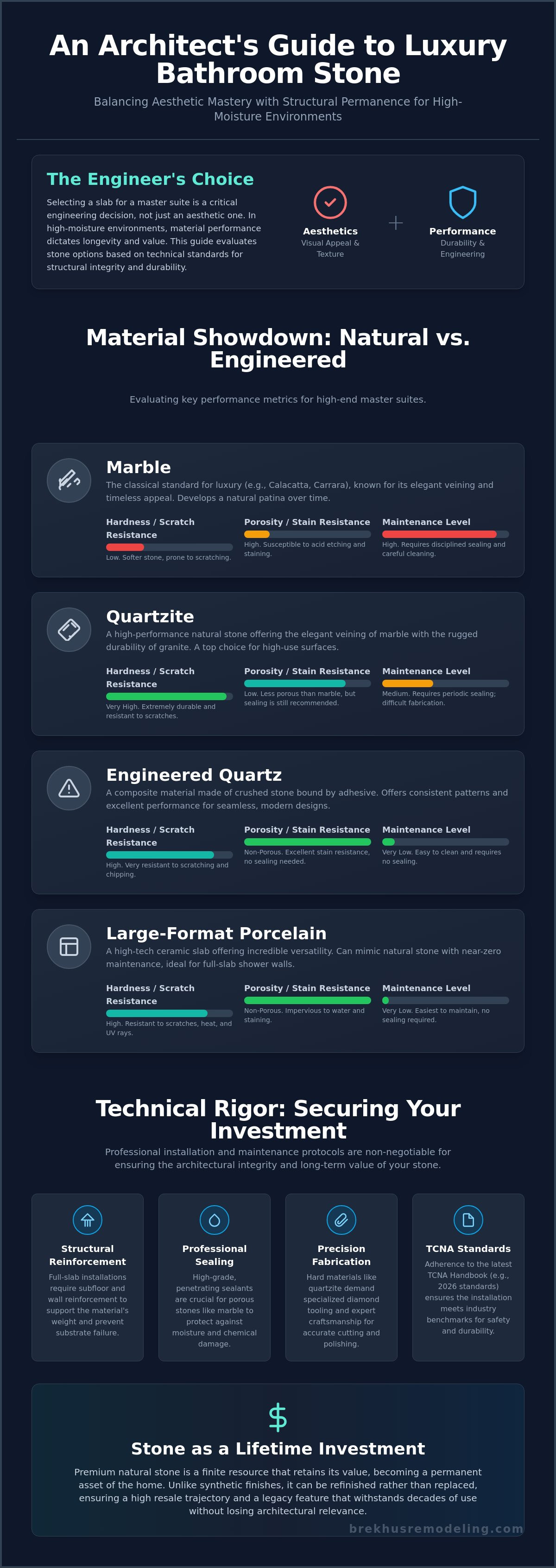
Selecting a slab for a master suite is often treated as a purely aesthetic exercise, but in a high-moisture environment, your choice of material is actually a complex engineering decision. You recognize that a premium finish must be matched by structural permanence to truly reflect the quality of your home. It's common to feel concerned about the porosity of marble or the rigorous weight requirements of large-format slabs when planning an investment of this caliber. This guide provides the technical clarity needed to evaluate luxury bathroom stone options with the precision of an architect.
You'll gain a definitive understanding of how various materials perform under the 2026 TCNA standards for stone installation. We'll clarify the critical differences between quartzite and engineered quartz while addressing the specific reinforcement needs for heavy natural stone. This review moves beyond surface-level trends to focus on the technical execution required for a bespoke renovation. By the end of this analysis, you'll have the confidence to select a stone that ensures both structural integrity and a significant increase in your estate's long-term value.
Key Takeaways
- Categorize luxury bathroom stone options by their porosity and hardness to ensure the material matches the specific moisture demands of your master suite.
- Identify the critical structural reinforcements required for full-slab installations to prevent substrate failure and maintain material warranties.
- Distinguish between the aesthetic appeal of marble and the rugged performance of quartzite to avoid common issues like etching or staining.
- Evaluate the benefits of large-format porcelain and engineered quartz as high-performance alternatives for seamless, low-maintenance designs.
- Implement professional sealing protocols and precision fabrication techniques to secure the long-term value and architectural integrity of your stone investment.
The Role of Stone in High-End Bathroom Design Services
High-performance architecture begins with the selection of raw materials that command presence and ensure longevity. In the context of a master suite, stone functions as the foundational design element that dictates the room's structural and visual rhythm. Professional bathroom design services leverage Dimension stone to create spaces that transcend temporary trends, focusing instead on the inherent value of natural geology. Selecting from the available luxury bathroom stone options is a decision that impacts everything from the subfloor reinforcement requirements to the final waterproofing integrity of the shower enclosure.
The distinction between decorative accents and structural stone applications is critical for high-stakes renovations. While a thin tile might suffice for a vanity backsplash, a full-slab shower wall requires a different level of technical engineering. Expert installers prioritize stone for its ability to withstand the thermal and hydraulic stresses of a luxury bathroom while maintaining an unyielding aesthetic standard. This intersection of organic beauty and rigorous performance is what defines the caliber of a bespoke build. It's not just about the surface; it's about the assembly of a permanent, high-functioning environment.
The Aesthetic vs. Functional Balance
The sensory experience of a master suite is heavily influenced by stone texture. A honed finish provides a grounded, organic feel, whereas a polished surface reflects light to expand the perceived volume of the space. Material selection must be dictated by specific moisture exposure zones. High-traffic floor areas require slip resistance and low porosity, while vertical surfaces allow for more delicate, high-veined varieties. Professional coordination ensures these diverse materials function as a cohesive system that meets the 2026 TCNA Handbook standards for safety and durability.
Stone as a Lifetime Investment
Investing in premium natural stone offers a superior return compared to temporary synthetic finishes. Since 2004, the standard for luxury Denver properties has increasingly favored materials that offer both durability and historical permanence. Natural stone is a finite resource that retains its value as a permanent asset of the home. Its ability to be refinished rather than replaced ensures the estate's resale trajectory remains high. When the installation follows precise engineering protocols, the stone becomes a legacy feature that withstands decades of use without losing its architectural relevance.
Primary Natural Stone Options: Marble, Quartzite, and Granite
The technical profile of a natural slab determines its suitability for a high-moisture environment. While many homeowners prioritize visual impact, the geological composition of luxury bathroom stone options dictates the long-term structural integrity of the master suite. Understanding the mineral properties of these materials allows for a design that resists degradation from steam, water, and chemical exposure. Selecting the wrong material for a high-use zone can lead to irreversible etching or moisture trapped within the stone's crystalline structure.
Marble Mastery: Managing Porosity and Etching
Marble remains the standard for classical luxury, but its calcium-based structure requires disciplined maintenance. Calacatta marble, characterized by bold veining and rarer availability, often commands a higher premium than the more common, grayish Carrara. Both materials are porous and susceptible to acid etching from common bathroom products like soaps and perfumes. Protecting this investment requires high-grade, penetrating sealants applied by specialists who understand the material's breathability. For many architects, the gradual development of a patina is an intentional design choice that reflects the stone's organic history.
Quartzite: The High-Performance Natural Alternative
Quartzite has emerged as the preferred choice for high-use vanity surfaces due to its extreme hardness. It offers the elegant veining of marble but possesses the rugged durability of granite. It's critical to differentiate genuine quartzite from mislabeled "soft" stones like dolomitic marble, which don't offer the same scratch resistance. The engineering required to fabricate these slabs is significant; cutting and polishing quartzite requires specialized diamond tooling and a high level of technical mastery. According to Dimension Stone Statistics and Information, the mineral density of quartzite makes it one of the most resilient materials available for residential construction.
Modern granite remains relevant through updated finishes. Honed or leathered textures replace the high-gloss look of previous decades, offering a sophisticated, organic feel that hides water spots effectively. For niche architectural styles, limestone and soapstone provide unique textures, though they require specific structural considerations due to their softer nature. Achieving a flawless result with these diverse materials requires a partner specialized in stone installation to ensure the substrate and waterproofing are engineered for the specific weight and porosity of the slab.
Modern Engineered Solutions: Quartz and Large-Format Porcelain
While natural geology provides unparalleled character, engineered surfaces offer a level of predictability required for modern architectural precision. These materials represent a significant segment of luxury bathroom stone options, specifically for clients prioritizing zero-maintenance performance in high-use environments. Manufactured slabs allow for a degree of aesthetic control that is difficult to achieve with quarried stone, ensuring that veining and color remain consistent across expansive master suite reconstructions. This predictability is a primary reason why modern bathroom design often integrates engineered solutions for large-scale vertical applications.
The decision between natural and manufactured surfaces often involves evaluating the acoustic and tactile profile of the room. Engineered stone typically possesses a different resonant frequency than natural granite or marble; it can feel slightly "cooler" or sound different when subjected to the impact of water. Architects frequently reference the Comparative Performance of Natural Stone and Manufactured Slabs when determining which material best suits the specific hydraulic demands of a steam shower or high-traffic vanity area.
Engineered Quartz in the Master Bath
Quartz consists of roughly 93% crushed natural minerals bound with high-performance resins. This composition creates a non-porous surface that is virtually immune to the staining and bacterial growth common in humid environments. It mimics the delicate veining of Calacatta without the inherent risk of acid etching from skincare products. However, technical limitations exist. The resin content makes quartz sensitive to extreme heat. Placing a high-wattage styling tool directly on the surface can cause permanent thermal shock or discoloration. It's a material designed for chemical resilience rather than thermal endurance.
The Technical Advantage of Sintered Stone and Porcelain
Sintered stone and large-format porcelain represent the cutting edge of manufactured surfaces. These materials are forged under immense pressure and temperatures exceeding 2,000 degrees Fahrenheit, resulting in a slab that is harder than granite and completely impervious to heat. Porcelain is becoming the standard for steam shower environments because it allows for a seamless, grout-free aesthetic with significantly reduced weight compared to natural stone slabs.
The installation of these ultra-thin slabs requires a level of technical rigor that many contractors overlook. While porcelain is incredibly durable once installed, it's brittle during the handling phase. Achieving a successful installation requires a perfectly level substrate; even a minor deflection in the wall framing can lead to cracking under load. This precision in assembly is what separates a high-end architectural execution from a standard renovation. The scratch resistance of modern sintered surfaces ensures the finish remains pristine even in high-traffic residential settings.

Strategic Applications: Full-Slab Showers and Integrated Elements
The architectural sophistication of a master suite is defined by the seamless transition of surfaces. While tile remains a standard choice, the highest expression of luxury bathroom stone options is found in full-slab applications. This approach eliminates the visual interruption of grout lines, allowing the natural geological narrative of the stone to remain unbroken. Achieving this monolithic look requires more than just high-quality material; it demands a rigorous understanding of stone fabrication and the mechanical requirements of the building's structure.
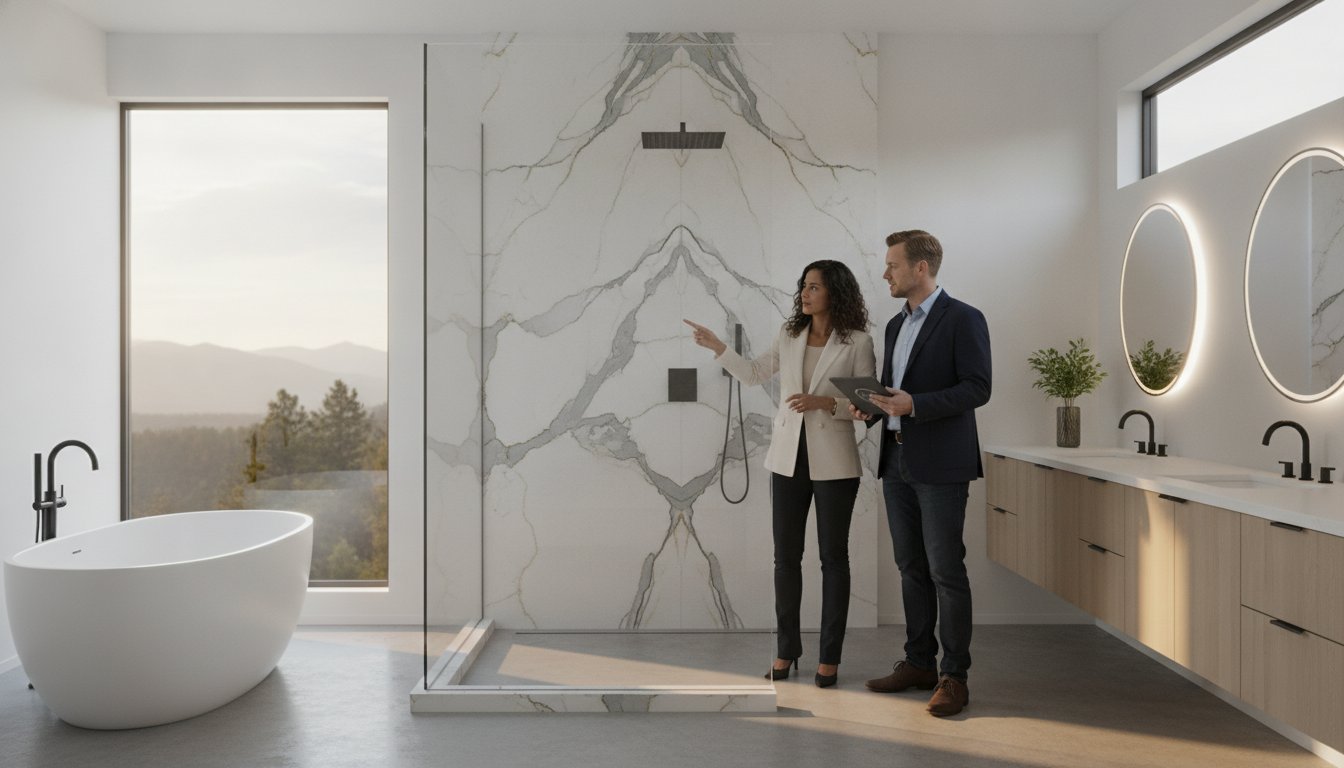
Visual impact is often maximized through vein-matching, or bookmatching. This process involves using sequential slabs from the same block, polished on opposite sides, to create a mirrored pattern. It's a technique that transforms a shower wall into a permanent piece of fine art. However, the alignment of these veins across corners and niche transitions requires a level of precision that only a master craftsman can provide. Every cut must be calculated to account for the thickness of the blade and the final mitered edge.
Engineering the Full-Slab Custom Shower
Installing floor-to-ceiling stone slabs introduces significant structural loads that standard residential framing isn't designed to carry. A single 3cm slab can weigh several hundred pounds, necessitating reinforced subfloors and wall studs. Precision waterproofing is the most critical component behind the stone. Because slabs are rigid, the substrate must be perfectly plumb and stable to prevent hairline fractures over time. Brekhus Remodeling manages these complexities through specialized slab rigging, using mechanical lifts and vacuum-sealed handling equipment to navigate large-format stone into tight residential spaces without compromising the material or the home's interior.
Bespoke Stone Details
Modern design often extends the use of stone into integrated elements like floating vanities and custom basins. An integrated stone sink creates a clean, monolithic aesthetic where the vanity top and the basin appear as a single unit. This requires expert mitered edges to ensure the joints are virtually invisible and completely watertight. These details are technically challenging because they must account for the stone's expansion and contraction.
Functionality is enhanced when stone flooring is coordinated with radiant heating systems. The thermal mass of natural stone makes it an ideal conductor, retaining heat and providing a consistent temperature across the floor surface. Curbless entry transitions and recessed niches further demonstrate the versatility of stone when the installation is planned with architectural intent. If you're ready to implement these complex features in your master suite, contact the experts at Brekhus Remodeling to discuss your project's technical requirements.
Technical Rigor in Stone Installation and Maintenance
The permanence of luxury bathroom stone options is dictated by the caliber of the installation rather than the material itself. High-end slabs are significant investments that require a rigorous engineering approach to ensure they remain structurally sound in high-moisture environments. A failure in the substrate or a lapse in waterproofing protocols can lead to catastrophic material damage that is often impossible to reverse. Professional execution focuses on the invisible layers behind the stone, where the true longevity of the master suite is established.
Environmental factors in Denver play a decisive role in material performance. The semi-arid climate creates extreme humidity differentials between the dry room air and the saturated environment of a custom shower. These conditions necessitate advanced adhesive systems that accommodate minor thermal expansion while maintaining a permanent bond. Without this technical foresight, even the hardest quartzite or most resilient porcelain can suffer from delamination or stress fractures over time.
The Brekhus Standard for Stone Installation
Substrate preparation is the most critical phase of a high-end stone build. Large-format slabs require a surface that is perfectly level and plumb to within minute tolerances. General tile setters often lack the specialized rigging and heavy-duty fabrication tools required to handle 3cm slabs with architectural precision. Our process involves a disciplined assessment of the wall framing and floor joists to ensure they can support the significant dead load of the stone. This meticulous attention to detail ensures tight seam tolerances and flawless alignment across every mitered edge.
Long-Term Stone Care and Restoration
Protecting your investment begins with professional sealing protocols on day one. Natural materials like marble and limestone require high-performance, penetrating sealers that shield the stone’s crystalline structure from moisture and chemical etching. Establishing a rigorous maintenance schedule is essential for preserving the stone's original luster. This includes the exclusive use of pH-neutral cleaners and periodic professional inspections to re-evaluate the integrity of the sealants.
Daily care should be supplemented by professional restoration every few years to address any minor surface wear or patina development. Maintaining a master suite of this caliber requires a partnership with experts who understand the science of the materials. To ensure your project meets these exacting standards, schedule a consultation for your custom stone installation with Brekhus Remodeling. Our team provides the technical mastery required to transform premium stone into a permanent architectural legacy.
Executing the Vision: Your 2026 Stone Strategy
Establishing a master suite with premium materials requires a shift from superficial design to rigorous architectural planning. You've evaluated the performance profiles of various luxury bathroom stone options, from the classic elegance of marble to the high-performance resilience of quartzite and sintered stone. Success in these high-stakes renovations depends entirely on the technical execution behind the slab. Proper substrate preparation, moisture management, and structural reinforcement are the invisible benchmarks of a superior build.
Since 2004, our team has focused exclusively on high-end residential standards in Denver, specializing in complex stone and custom shower engineering. We understand that a bespoke renovation is an investment in your estate's long-term value. Achieving a flawless, monolithic aesthetic requires a partner committed to professional rigor and technical precision. Consult the Denver Experts in Custom Stone and Bathroom Remodeling to ensure your next project is built to the highest standard of excellence. Your vision for a timeless, structurally sound master suite is within reach through disciplined craftsmanship.
Frequently Asked Questions
Which stone is best for a high-moisture steam shower?
Sintered stone and large-format porcelain are the technical standards for steam shower environments. These materials are impervious to the thermal stress and constant humidity that can degrade more porous natural materials over time. If a natural aesthetic is required, quartzite provides the necessary density, provided the installation includes a high-performance waterproofing membrane behind the slab.
How often does luxury natural stone actually need to be sealed?
High-moisture zones generally require professional sealing every 6 to 12 months to maintain structural integrity. The specific frequency depends on the porosity of your luxury bathroom stone options and the chemical profile of your daily cleaning products. A simple water-bead test can determine if the protective barrier remains intact or if the stone has begun to absorb moisture.
Is quartzite more durable than granite for a bathroom vanity?
Quartzite is technically harder than granite and offers superior resistance to scratches and abrasions. On the Mohs scale of mineral hardness, quartzite typically ranks at a 7, while granite falls between 6 and 6.5. While both materials are suitable for high-end vanities, quartzite provides a more sophisticated, marble-like appearance without compromising on the rugged performance required for daily use.
Can I use marble in a master bathroom if I am worried about maintenance?
Marble is a viable option for master bathrooms if you specify a honed finish rather than a polished surface. Honed marble hides acid etching from soaps and perfumes more effectively and develops a graceful patina that many architects find desirable. You must utilize pH-neutral cleaners and ensure the stone is treated with a premium, penetrating sealer to manage its natural porosity.
What are the structural requirements for installing full-slab stone walls?
Full-slab installations require reinforced wall studs and a substrate that is perfectly plumb to manage significant dead loads. A standard 3cm slab can weigh between 15 and 20 pounds per square foot, necessitating a review of the floor joists and wall framing. These reinforcements ensure the structure can support the stone without deflection, which could otherwise lead to hairline fractures.
How does vein-matching (bookmatching) work with natural stone slabs?
Bookmatching is achieved by polishing two sequential slabs from the same block on opposite sides. When installed side-by-side, the veining mirrors itself across the seam to create a symmetrical, kaleidoscopic effect. This technique is a hallmark of bespoke design and is most effective when used on expansive vertical surfaces like shower walls or focal-point backdrops.
Is engineered quartz better than natural stone for bathrooms?
Engineered quartz offers superior stain resistance and color consistency, but it lacks the heat resistance of natural stone. The resins used to bind quartz can suffer from thermal shock if exposed to high-heat styling tools. Natural stone provides a unique geological character and superior thermal endurance, though it requires more disciplined sealing and maintenance protocols.
How do I prevent my stone shower floor from being slippery?
Preventing slippage requires selecting a stone with a textured finish, such as a honed, leathered, or sandblasted surface. These finishes increase the coefficient of friction to provide better traction in wet conditions. Incorporating smaller format tiles or mosaics also helps, as the increased frequency of grout lines provides additional mechanical grip for the feet.